How to Dry & Store Rose Hips for Rose Hip Tea

Rose Hip Tea (Rosa canina) is so refreshing and packed with vitamins and minerals. A great hot Winter time drink. Delicately sweet, this is one of my favourites, and I consume it daily throughout the Dark Months.

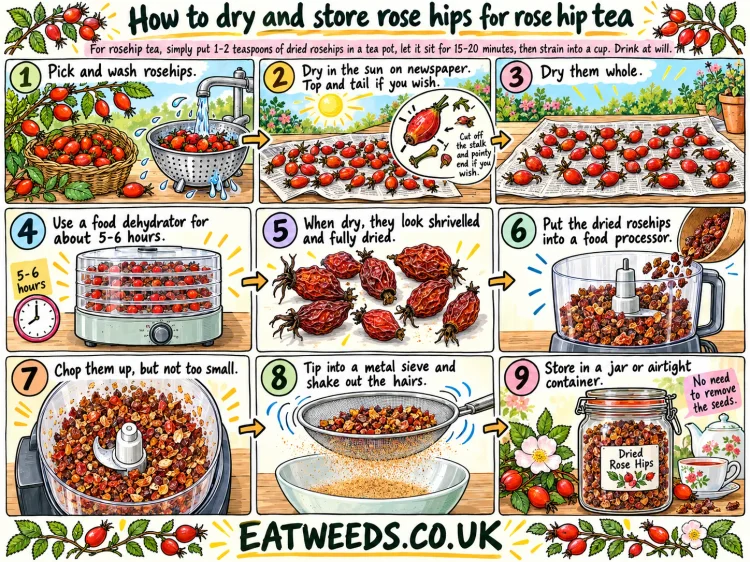
For rose hip tea, simply put 1-2 teaspoons of dried rose hips in a tea pot, let it sit for 15-20 minutes, then strain into a cup. Drink at will.

Step 1

Pick as many rose hips as you think you need to last you until next year. I also wash them first.

Step 2

After washing your rose hips, dry them in the sun on newspaper. Then top and tail them by removing the stalk and the little pointy bit where the flower was. This isn’t important, but I do it.

Step 3

Normally I dry them whole, but this year I decided to test splitting 50% of the batch in half before drying. This made absolutely no difference, other than pleasure-ably wasting time :-)

Step 4

For convenience and because the weather has not exactly been that sunny this year (2008), I used a food dehydrator.

Dehydration took about 5-6 hours for this particular batch. But this is “wild stuff”, so times may vary depending on the quality of the hips, how many you’re drying etc.

Step 5

When the rose hips have dried, this is what they look like.

Step 6

Next put them in a food processor. This year I borrowed my neighbours small one and it worked very well.

Step 7

Grind away until the contents look like below… you don’t want to grind the rose hips too small other wise in the next step they will simply fall through the sieve along with all the hairs… which kind of defeats the object of sieving (Step 8)!

Step 8

Tip the contents into a metal sieve, and just shake to remove all those pesky hairs that can be irritating to some people. I find it fascinating that they all easily fall through leaving you with some scrummy dried rose hips.

Step 9

Tip the dried rose hips into a jar or air tight container, and consume at will.

There is no need to go to the trouble of removing the seeds (unless you have more time on your hands than you know what to do with).

Share & Bookmark This Story!

{ 1 trackback }

The Cottage Smallholder » Make your own rosehip tea
October 14, 2009 at 10:27 am

{ 30 comments… read them below or add one }

patricia hill September 28, 2008 at 12:15 pm

Hi, I was interested in this rosehip information. I have a wonderful rosehip syrup recipe, which I made for my girls, as they were growing up. I have passed it on to several other mums, over the years. i was wondering if it is of any nutricional value, to use hawthorn berries, in the same way? down here, in cornwall, I have not seen too many rosehips in my area. there is an abundance of hawthorn/may berries. I have collected fungi over the years and have passed my small knowledge onto my daughter, but I still have to return to my book to refresh, as my memory is intermittant!!!! Luckily, I marked all the ones I found, that i was happy with.!! thankyou for an interesting newsletter, it is fun recieving it and my daughter reads it too. so…double pleasre. Oh, and….having got the writen version of the wood/pasture, the item below this one, it would have been noce to see pictures of the area. I was dying to be shown round. haha! thanks anyway….keep up the great work….patricia hill

Robin September 29, 2008 at 8:15 am

I haven’t tried drying hawthorn berries for tea, but it’s on my list. Foraging is as much about experimenting as it is about following the trails that others have walked before us.

So go ahead and experiment, but if you have any kind of heart condition I’d check out with a herbalist just how much hawthorn you can take, because it borders on the food/drug spectrum, rather than just being safely in the food category.

Young hawthorn leaves have been used as a tea substitute, and the roasted seed has been used as a coffee substitute.

Ce Walker October 1, 2008 at 12:55 pm

I have read your way of drying Rose Hip’s very interesting. I’m from Cambridgshire and we too have had an abundence of Hips and Haw’s and Blackberries. We have made Blackberry Vodka, is there anything similar one could do with Hip’s.

Robin October 2, 2008 at 1:31 pm

Ce, you’ll find a recipe for Rose Hip and Anise Liqueur here. You’ll need to scroll down to find it.

For Rose Hip liqueur, click here

And you’ll find a recipe for Rose Hip vodka here. The recipe is in the comments made by Abi on October 25th, 2007 .
Hope that helps.

Jeff October 7, 2008 at 5:49 am

I have read that the seeds contain cyanide, is it truly safe to consume the tea with ground seeds?

Robin October 7, 2008 at 8:35 am

Jeff that’s a good question. Please read my article here for my reply.

Steve Cartwright October 20, 2008 at 10:25 am

Just a tip about drying rosehips. You can also dry them in a warm , not hot, oven. Put the whole rose hips in roasting trays about a half inch deep and heat the oven up to about 50 degrees C for about an hour. Leave the oven door ajar (you can hold it open with a tea spoon or folded tea towel) and leave the rose hips in there as the oven cools down. This ensures that the rose hips dry out: be careful they don’t cook. Do this every day for about a week, making sure to shake the rosehips every so often. When they’re dry, store them in a wooden or cardboard box. My wife is from Siberia. I learned this from her.

Robin October 21, 2008 at 8:01 am

Steve that’s a great tip, thanks. My only observation is that you might be better off buying a cheap food dehydrator, simply because turning the oven on for an hour a day on low, uses a lot of energy, and while the door is open the heat is escaping, meaning wasted energy.

OK I’m most probably being picky here…

Ouissi October 23, 2008 at 10:39 am

looks amazing!! Does anyone know where you can buy rosehips in the UK or by mail order??? I don’t have a garden s o cannot grow anthing ;(

Robin October 23, 2008 at 1:23 pm

Ouissi, you’ll find rose hips all around you if you go for a walk and look out for them. You don’t need to grow them as they grow wild. You’ll find them in parks, hedgerows, fields etc.

paul November 1, 2008 at 10:50 am

hi
im just getting into rose hips and was wandering can any variety be eaten?
the hips you show if the same ive seen growing on small hedges in supermarket car parks and also as quite large trees else where.
ive also seen a small purple/black colour growing on sand dunes a little bigger than grapes but the size could be to lack of nutrients?
would any kind be edible/worth eating do you now.
thanks paul.

Robin November 1, 2008 at 11:22 am

All roses produce edible fruits, but some have more flesh and some taste better than others.

Regarding your purple/black fruit, in a word, I don’t know. You’ll need to positively identify the plant you have found. You might just have found a rose that’s getting old and rotten. But I wouldn’t be able to say unless I actually saw what you are talking about. Sorry to not be more help on this one.

Hazera November 4, 2008 at 12:43 am

Hi

I used to see rose hips that looked like small beef tomatoes on rose bushes on the way to school, which also had a really fleshy texture and were really tasty. I don’t know what they were called but I would like to find out what they were. I see them in a lot of places that have managed hedges like on estates and so on. I would love to try making them into a jam.

Robin November 4, 2008 at 7:20 am

I suspect that what you are talking about is Rosa rugosa known over here in the UK as the Japanese Rose. It’s pretty common in cultivated gardens and in public spaces managed by councils etc.

Laci December 21, 2008 at 10:19 pm

When is the best time of the year to pick rosehips?

Paul May 15, 2009 at 8:55 am

Sounds like a silly question but can you use dog rosehips for tea?

Robin May 17, 2009 at 7:36 am

Laci: The best time is meant to be just after a frost, however because we don’t have “frosts” so to speak where I live in Devon, I simply pick them when they are firm and ripe. Like the pictures above.

Paul: Sure you can use Dog Rose (Rosa canina), it makes no difference.

Paul May 21, 2009 at 2:12 pm

Silly question time!! With the finished product do you just place them into an infuser (forgive spelling pls) for the wonderful tea, i have only had them in bags before.

Robin May 22, 2009 at 9:29 am

Paul: You got it. Just add 2-3 teaspoons either to a teapot or use a tea infuser and allow to steep for about 10 minutes.

jane August 7, 2009 at 3:16 am

founds heaps of info onhere that great, just need to find a darn good syrup recipe now,also would they be any good frozen until i want to make more syrup as the syrups generally have a limited shelf life??
Thanks

Robin August 10, 2009 at 7:52 am

Jane: To be honest I have never used frozen rosehips so don’t know, but I suspect they might go a bit mushy. Whether that will effect the flavour is something you will have to try out. With regards to a decent rosehip recipe, I’ll be producing one later in the year.

Mary August 21, 2009 at 10:44 am

Is it OK to use Rosa rugosa to make rose hip syrup

Robin August 23, 2009 at 5:39 pm

Mary: I have not used them for syrup but eat them alot when they are out, so they should be fine for syrup.

Liz Dillon October 12, 2009 at 9:50 pm

Hi – I just had a look at this page this eve – wonderfully inspired!!
I met Zilla at Trill Farm weekend before last and had been meaning to look up your site but actually found it by accident when I was looking to find out when rosehips are in season until….as living in London haven’t quite yet found where to forage for rosehips – except found a few last week on a street hanging out of a garden calling out to me!
I was wondering if I am running out of time to find some rose hips….
will be on a search this weekend – say hi to Zilla from me (liz) can’t wait to check out the site more!

Robin October 14, 2009 at 9:44 am

Lis: I forwarded your ‘Hi’ to Zillah. Regarding harvesting Rosehips, they will be around for a good while yet or until the critters much them all!

David October 27, 2009 at 3:02 pm

Thank you, this was the best guide for this. Great pictures too.

The dried fruit was delicious, and my first batch of tea is brewing as I type. I made the mistake of blending the powder far too much trying to make a finepowder, for some reason I thought the aim was to sieve the fruit powder out leaving the hair. Doh.

My powder with the dried hair fuzz is great though, I think they loose the irretating properties when dried.

Oh, and I used a home made dehydrater too I also use for making beef jerky! A man called Lex takes all the credit for this cheap, economical and effective little beauty. Here are the build instructions….

http://www.rawpaleodiet.com/wp-content/uploads/2009/04/jerkydrierinstructions.pdf

Thanks again for the information,

David, 22, London

Diana November 28, 2009 at 10:22 pm

Hi, I have a very large yellow rose bush that has huge rose hips on it. They are the size of .50 cent pieces. I have been waiting for them to sort of ripen on the stems but they are still not rosy red all the way around and I’m afraid if I leave them longer, a freeze will ruin them. I picked them today and am oven drying them. Do you think it’s OK or have I made a mistake?
Nana Diana

Robin November 30, 2009 at 10:59 am

Diana: For drying then yes get them in before the freeze, for making jams/syrups etc. it sometimes helps if they are picked after a frost as the cold breaks down the fibres thereby allowing more flavour to come out. I don’t know what species of Rose you are referring to, so best to just experiment. I can’t see them being a little yellow to be too much a problem, it just might make for a more sour hip drink. Good luck.

Frances November 30, 2009 at 9:56 pm

Thank you for such delightful information. I am from the US. My daughter has a house that has many roses and I have wild roses on my small “farmette” (that is a want to be farm). I have looked at different places, but I think your blog has been the most informative for me.
Thank you.

Surender Kumar January 26, 2010 at 11:13 am

Thanks for showing a nice way to dry and remove hairs of Rose Hips. I found it very helpful as we also collect the wild Rose Hips in Kullu Valley India on small scale for research…therefore need to dry and remove the hairs before sending for the tests..

Leave a Comment