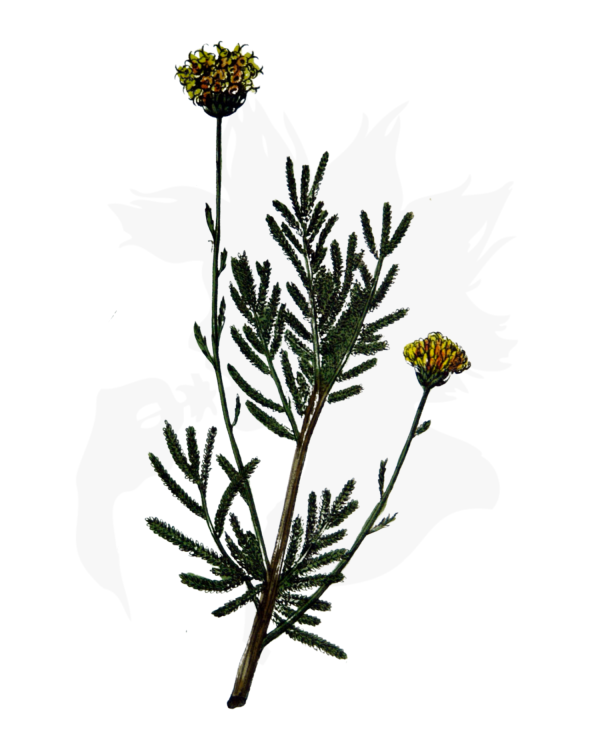
I remember the first time I met Cotton Lavender (Santolina chamaecyparissus). I had moved to Exeter in Devon. As I walked past the hospital, I noticed a silvery-grey plant with bright yellow blooms. Hospitals often have lovely gardens.
Following my habit of sniffing everything, I picked a leaf, crushed it, and took a deep breath.
Immediately, lavender notes combined with camphor hit me. I had never heard anyone mention this plant as forageable. It’s not wild; it’s ornamental. Still, I wanted to learn more.
What I discovered is that the leaves can flavour broths or grain dishes. It’s not a vegetable; it’s a seasoning. People haven’t used the plant itself much as food.
There are some notes on it, but if you examine the research closely, a big gap becomes evident. The food industry looks at it through a phytochemical lens. Ethnobotanical studies show different results.
The food industry loves to latch onto any new research about a plant’s potential. They quickly brand it as a wonder herb, often based on limited lab results.
Phytochemistry shows us that the plant is edible, but only in small amounts.
Mediterranean folk medicine interestingly includes cotton lavender, which has a rich and well-documented history.
It’s less common now and has gone out of favour. However, it was once used as a vermifuge (to treat worms), to induce periods, as a stomachic (to boost function), and as an antiseptic.
One of its best uses, especially as the climate warms and more pesky bugs appear, is that you can crush the leaves between your fingers. Then, press the bruised leaf onto a sting or bite, and the pain eases almost immediately.
This is worth bearing in mind when you’re out and getting nibbled. People have also used it as a wound herb, and it is said to speed up scarring.
In Ayurveda, it supports liver health. I don’t know much more, but it’s worth looking into yourself.
One warning: if you have sensitive skin, the bruised leaf can cause a rash, so test it first. This plant sits firmly on the fringes of food-medicine, and it’s one to work with slowly.
Don’t dive in and start loading your dishes with it just because it’s a pretty spice with unique chemistry. Slow and steady, please with this plant.