Your lungs stop working whilst your mind stays clear.
Hemlock doesn’t kill you like arsenic or cyanide. There’s no dramatic collapse, no frothing at the mouth.
Instead, something far more sinister happens.
The alkaloids in Conium maculatum bind to the receptors in your nervous system. The same receptors that normally help your muscles contract when your brain tells them to.
First, they stimulate. Your muscles twitch. You might feel tremors, your heart races. This phase doesn’t last long.
Then comes the paralysis.
Starting with your extremities and working inward, your muscles simply stop responding. Your arms won’t lift. Your legs won’t move.
And then it reaches your diaphragm.
The truly horrifying part? Your consciousness remains intact. You’re fully aware as your breathing becomes shallower, as your chest refuses to expand, as suffocation slowly takes hold.
This is how Socrates died in 399 BCE, after Athens sentenced him to death for corrupting the youth and impiety.
The execution method was a cup of hemlock. Plato’s account describes him losing sensation in his legs first, the numbness creeping upward, until finally his heart stopped.
Modern cases still occur. People mistake it for wild carrot or parsley. Livestock graze on it in contaminated pastures.
If treatment arrives quickly enough: mechanical ventilation, supportive care. Survival is possible. But there’s no antidote. Just life support until the toxins clear your system.
The ancient Greeks understood this plant’s power well enough to make it their state-sanctioned instrument of death.
Have you encountered hemlock growing near your home?
Description.
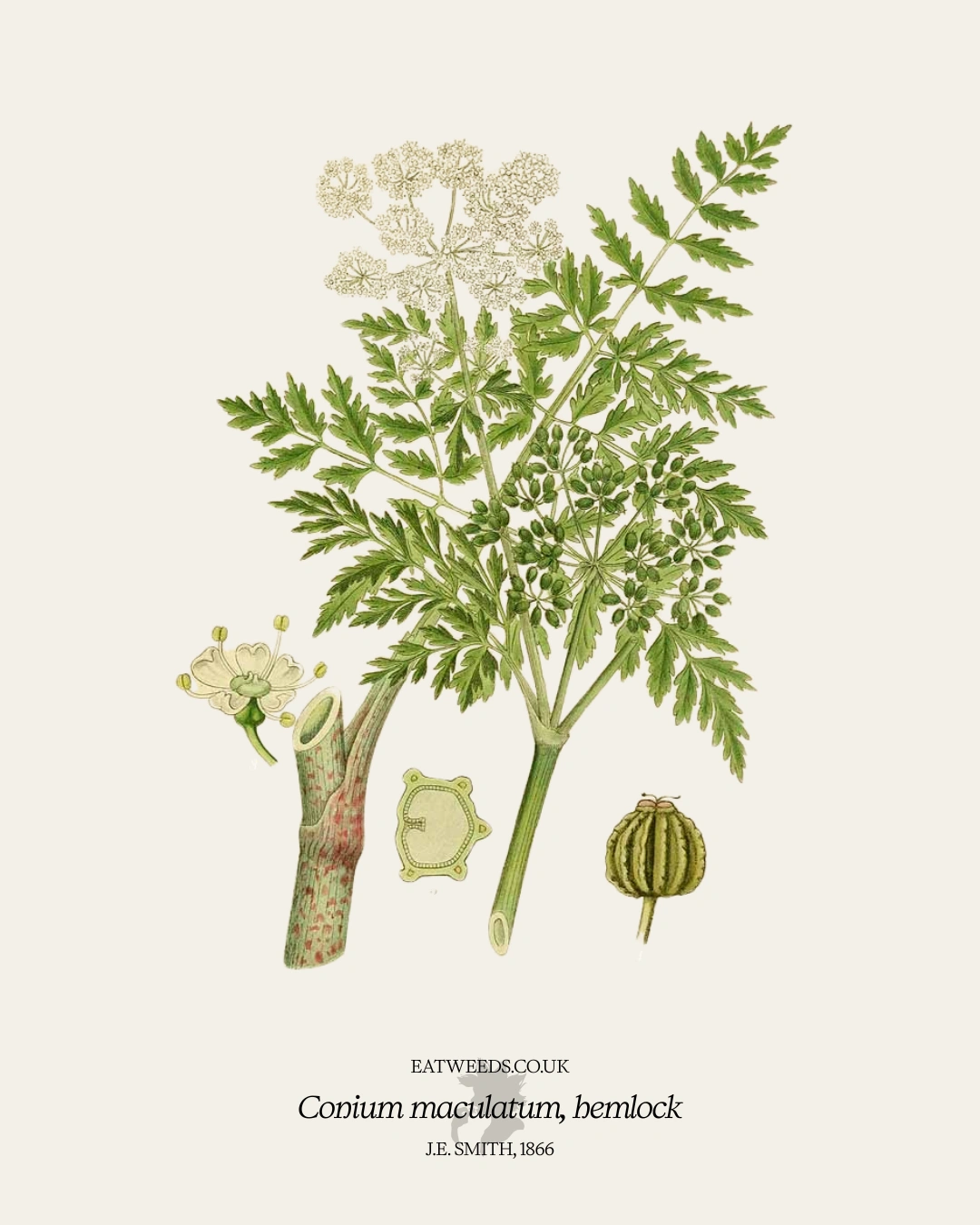
Conium maculatum grows tall. Up to 2.5 metres. Robust. Branching everywhere. It’s a member of the Apiaceae family.
Here’s how you spot it: smooth, hollow stems covered in purple blotches. Like someone’s flicked paint at it.
The leaves? Delicate. Fern-like. Almost pretty. They’re divided into wedge-shaped segments with toothed edges. White flowers bloom in umbrella clusters from June through July.
Crush any part of this plant and you’ll smell it. Unpleasant. Mousy. Your nose wrinkles telling you what your brain needs to know: stay away.
You’ll find hemlock along riverbanks, ditches, and roadsides throughout Britain. Less common up in northern Scotland, but it’s there.
Look, you need to know about hemlock. Because this plant could kill you! Every single part of this plant is poisonous. The leaves. The stems. The flowers. The seeds. Everything.
Know it. Respect it. Don’t touch it.
Dig deeper.
References
Nunes, J., Pina, S., Oliveira, A., Moreno, J., & Pérez, P. (2025). Acute Intoxication With Poison Hemlock (Conium maculatum). Cureus, 17. https://doi.org/10.7759/cureus.80763
Karakasi, M., Tologkos, S., Papadatou, V., Raikos, N., Lambropoulou, M., & Pavlidis, P. (2019). Conium maculatum intoxication: Literature review and case report on hemlock poisoning.. Forensic science review, 31 1, 23-36.
West, P., Horowitz, B., Montanaro, M., & Lindsay, J. (2009). Poison Hemlock-Induced Respiratory Failure in a Toddler. Pediatric Emergency Care, 25, 761-763. https://doi.org/10.1097/pec.0b013e3181bec925
Konca, Ç., Kahramaner, Z., Boşnak, M., & Kocamaz, H. (2014). Hemlock (Conium Maculatum) Poisoning In A Child. Turkish Journal of Emergency Medicine, 14, 34 – 36. https://doi.org/10.5505/1304.7361.2013.23500
Boskabadi, J., Askari, Z., Zakariaei, Z., Fakhar, M., & Tabaripour, R. (2021). Mild‐to‐severe poisoning due to Conium maculatum as toxic herb: A case series. Clinical Case Reports, 9. https://doi.org/10.1002/ccr3.4509
Hotti, H., & Rischer, H. (2017). The killer of Socrates: Coniine and Related Alkaloids in the Plant Kingdom. Molecules : A Journal of Synthetic Chemistry and Natural Product Chemistry, 22. https://doi.org/10.3390/molecules22111962
Schep, L., Slaughter, R., & Beasley, D. (2009). Nicotinic plant poisoning. Clinical Toxicology, 47, 771 – 781. https://doi.org/10.1080/15563650903252186
López, T., Cid, M., & Bianchini, M. (1999). Biochemistry of hemlock (Conium maculatum L.) alkaloids and their acute and chronic toxicity in livestock. A review.. Toxicon : official journal of the International Society on Toxinology, 37 6, 841-65. https://doi.org/10.1016/s0041-0101(98)00204-9