Warning: Caveat Actor (“Let the doer beware”). The preparation of these plants is inherently dangerous; proceed at your own risk.
I’ve got a very personal reason for respecting lords-and-ladies (Arum maculatum). When I was 16, I learnt the hard way what this plant can do.
I was having a crafty cigarette in the woods with my mates. Wild garlic had pushed through, and I spotted from the corner of my eye what I thought was a very large wild garlic leaf.
We used to cover up the smell of smoking with either mints or, in wild garlic season, by chewing the leaves. Seemed clever at the time.
So I picked this leaf, chewed the stalk, and within seconds felt like I’d just eaten crushed glass.
I swallowed a little bit of the juice. For the next six hours the nausea was extreme. The reason I didn’t go and seek help was because the punishment for smoking was more severe than death!
That was lords-and-ladies. Not wild garlic.
Now, decades later, I’ve walked past this plant thousands of times. You’ve probably done the same.
It’s common as muck in shaded spots across Britain, pops up every spring with those distinctive arrow-shaped leaves that can look deceptively similar to wild garlic if you’re not paying attention.
The foliage and berries are poisonous. Almost in the same league of deadliness as hemlock and bryony.
I was told of an incident where a child chewed on the autumn berries and ended up with the oral cavity blistering and swelling to the point where breathing became difficult. I know exactly what that child went through.
And yet, and here’s where it gets interesting, centuries ago, people harvested these roots on a small industrial scale for starch production.
The Process
I was taught this process by my first foraging mentor, Marcus Harrison. It’s the same one that ethnobotanist Gordon Hillman carried out for the Wild Food book with Ray Mears. Marcus was consulted by Mears for the TV series. It’s laborious.
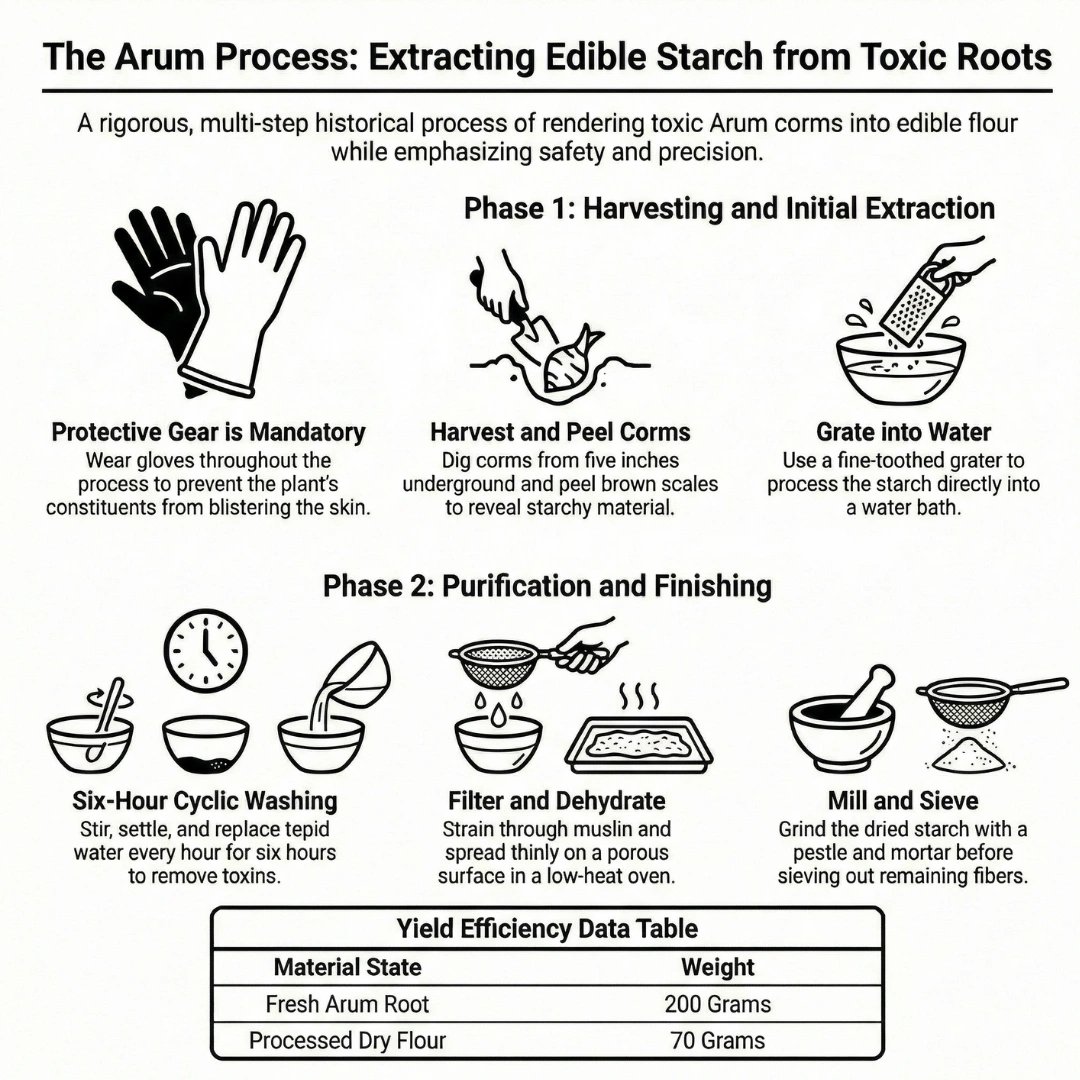
- Dig up the corms from about four or five inches below ground. Larger ones are maybe one and a half to two inches in diameter, roughly round.
- Put on gloves. The constituents will blister your skin.
- Peel off the brown scale-like skin to reveal the starchy material inside. When the roots are at their prime, the starch literally oozes onto your gloved fingers.
- Grate the starchy material into water using a fine-toothed grater.
- Stir the gratings thoroughly and let the starch settle at the bottom.
- Pour off the water with the cellular material.
- Add tepid water (not hot, which would dissolve the starch) and stir thoroughly.
- Repeat steps 5–7 every hour for about six hours.
- After the final washing, filter the starch through kitchen tissue or fine muslin.
- Spread the starch thinly on a porous surface and dry it in an oven at very low temperature.
- Grind the dried starch using a pestle and mortar.
- Sieve it to remove any remaining fibrous content.
Two hundred grams of fresh root yields about seventy grams of dry flour. That’s a lot of work for minimal return.
The flour is almost tasteless, turns translucent like arrowroot when cooked.
But should you try this yourself?
Probably not. There are far easier ways to get starch. This takes no prisoners if you get it wrong. No tasting raw roots, no experimenting with other parts of the plant, keep all other foodstuffs well away from the processing area. I learned that lesson at 16, and I’m not eager to repeat it.
What matters is understanding what’s possible. Our ancestors turned toxic plants into food through knowledge and patience. They had to.
That’s the principle worth learning, not the specific recipe, but the mindset. The careful observation, the precise process, the respect for what plants can and can’t give us.
You make your own decisions about lords-and-ladies. Just make sure you know exactly what you’re looking at first.
Lots of photos here, showing the plant at different stages of its growth cycle.