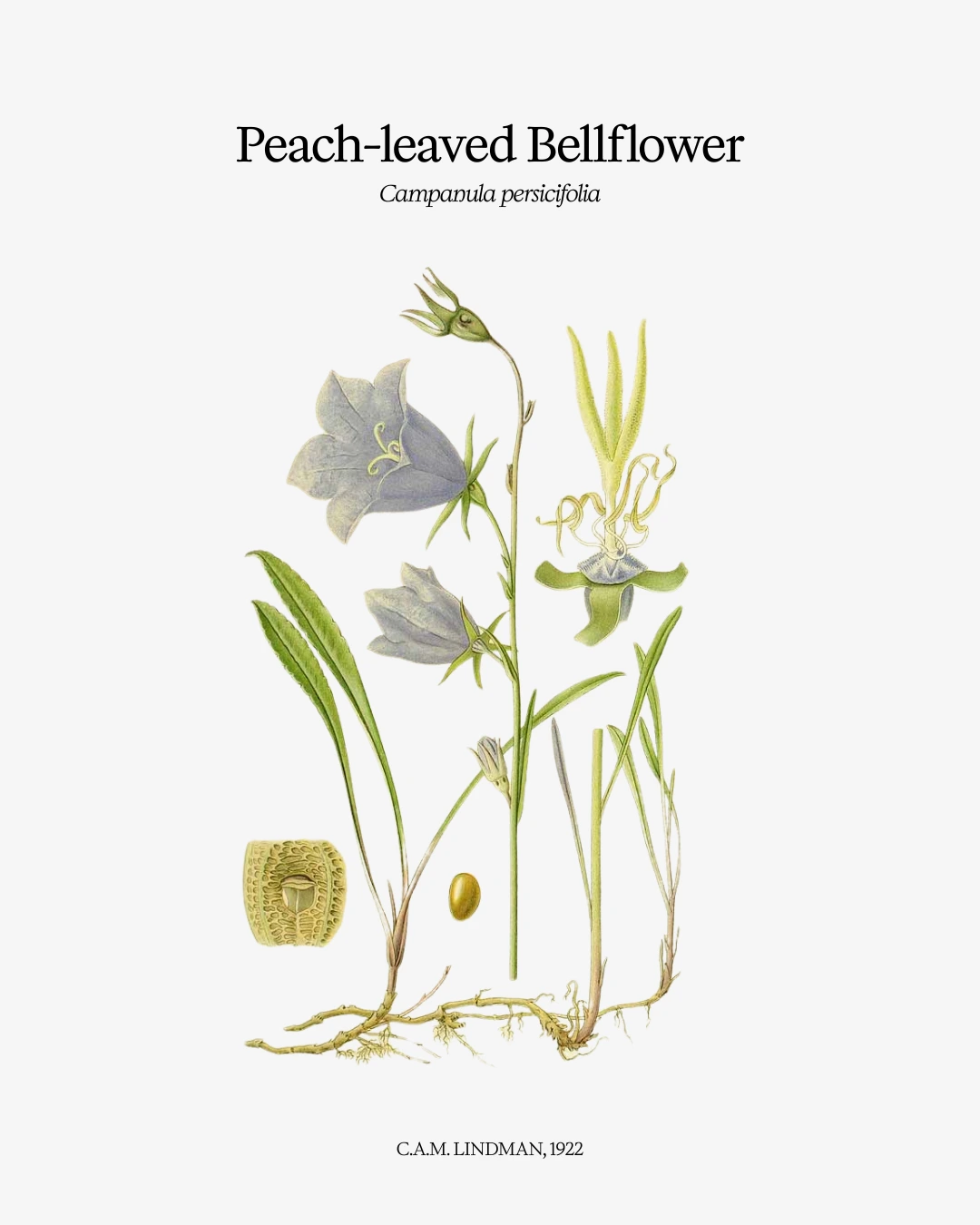
Common name
Peach-leaved Bellflower
Scientific name
Campanula persicifolia
Family
Campanulaceae (Bellflower family)
Botanical description
A perennial that grows up to 90 cm, spreading slowly by short rhizomes.
It forms a basal rosette of narrow, strap-like leaves that often persist through winter.
Upper stem leaves wither before flowering. Smooth upright stems carry loose racemes of violet-blue, bell-shaped blooms from June to August. White forms are also found.
Each flower has five lobes, outward-splaying calyx teeth, and a style divided into three stigmas.
Status
Native to Europe and Asia, now widely cultivated and often naturalised in temperate regions.
Habitat and distribution
Thrives in meadows, woodland edges, and rocky slopes. In Britain it is often seen along roadsides and hedgerows, a garden escape that adapts well to both sun and shade.
Parts used for food
Leaves, flowers, and roots.
Harvest time
Basal leaves: autumn to spring.
Flowers: June to August.
Roots: best in autumn.
Food uses
Young leaves taste mild and pea-like, eaten raw in salads or lightly cooked.
Older leaves work as cooked greens, though their size means more gathering.
Flowers are sweet, eaten fresh, and add colour to salads.
Roots are mild and earthy, similar to Campanula rapunculoides, eaten raw or cooked.
Nutritional profile
Flowers contain high levels of vitamin C (36.9–114 mg per 100 g) and carotenoids such as lutein, zeaxanthin, and beta-carotene. They are also rich in fibre and minerals like phosphorus and potassium.
Compounds include catechins, flavonols, and tannins, offering antioxidant and anti-inflammatory potential.
Traditional medicine uses
Though rarely cited in formal texts, folk remedies in Europe used the plant for coughs, digestive upsets, headaches, and even epilepsy.
Comparable species across the genus — from North America to Korea — were employed for respiratory and inflammatory conditions, suggesting overlapping properties.
Other uses
Long-flowering and attractive to pollinators, it is valued in gardens as well as in cut flower arrangements.
Cautions
Non-toxic and generally safe to eat.
Misidentification is the main risk: monkshood (Aconitum) and larkspur (Delphinium) are poisonous lookalikes, but both differ in flower form and foliage. Always check carefully before harvesting.
Even safe plants can upset the stomach if eaten to excess.
References
- Missouri Botanical Garden. “Campanula persicifolia – Plant Finder.” Accessed September 7, 2025. https://www.missouribotanicalgarden.org/PlantFinder/PlantFinderDetails.aspx?taxonid=278819
- Go Botany – Native Plant Trust. “Campanula persicifolia (peach-leaved bellflower).” Accessed September 7, 2025. https://gobotany.nativeplanttrust.org/species/campanula/persicifolia
- Wildflower Web. “Peach-Leaved Bellflower Plant.” Accessed September 7, 2025. http://www.wildflowerweb.co.uk/plant/1492/peach-leaved-bellflower
- Kuczkowska, A., et al. “Flowers of Campanula species as a source of biologically active substances.” BIO Web of Conferences 31 (2021): 00033.
- ResearchGate. “Campanula latifola, Giant Bellflower: Ethno-Botany, Phytochemical and Antioxidant Evaluation.” Accessed September 7, 2025.
- PMC. “Antinociception Effect and Mechanisms of Campanula Punctata Extract in the Mouse.” https://pmc.ncbi.nlm.nih.gov/articles/PMC2997413/
- PMC. “Chemical Constituents of the Leaves of Campanula takesimana and Their Inhibitory Effects on LPS-induced PGE2 Production.” https://pmc.ncbi.nlm.nih.gov/articles/PMC7570004/
- Plant Detectives. “The Campanula Guide.” Accessed September 7, 2025. https://plantdetectives.com/pages/the-campanula-guide