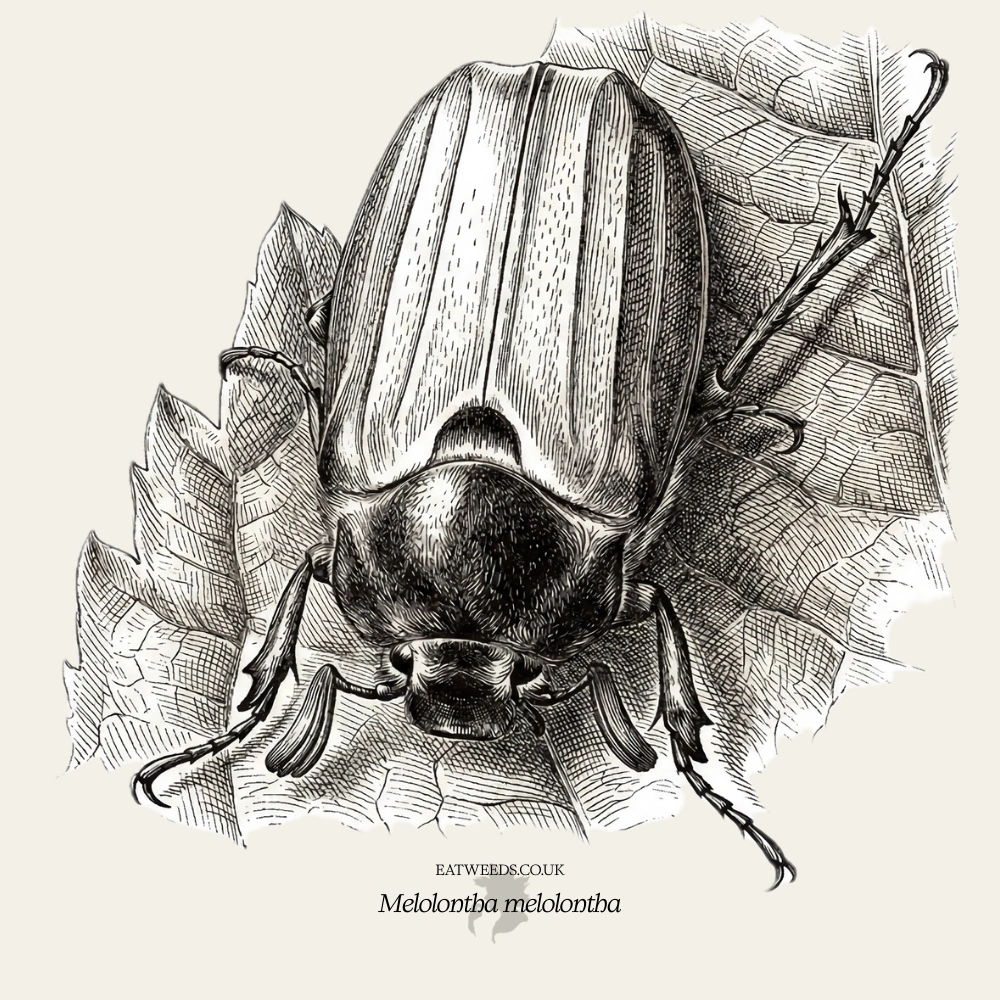
Cockchafer soup is made in the same way as crayfish soup.
Allow roughly thirty beetles per person. Wash them as soon as they are caught, then crush them whole in a mortar, sauté in hot butter, and simmer in meat stock.
Strain thoroughly and serve over slices of toasted bread.
Even a thin stock is transformed by the beetles into something remarkable.
A well-made cockchafer soup is richer, more flavourful, and more nourishing than crayfish soup.
The smell is pleasant; the colour a warm brownish tone, close to that of the beetle’s wing casing.
Only prejudice stands between this excellent food and the people who would benefit most from it – the weak and the recovering.
Once that prejudice is overcome, the soup would be a genuine asset in hospitals and barracks, where it could serve admirably even when made with water alone.
I find it hard to understand why the cockchafer has been so overlooked. Is it really more off-putting than the mud crabs from which those celebrated and costly crayfish soups are prepared?
Every guest who has eaten cockchafer soup at my table – without knowing what it was – has asked for second and even third helpings.
If deception is required, a handful of crayfish added to the pot will turn the soup red, and it will pass convincingly for an excellent crayfish soup, particularly if a few tails remain visible.
One further note: beetles that have been feeding on oak leaves are less desirable, as they leave a harsh, astringent aftertaste.
The beetles should be taken alive and fresh from the tree.
Anyone who dismisses these soups as a novelty is quite wrong. They are, simply, a fine source of nourishment.
The stag beetle (Lucanus cervus) is said to produce an even more fortifying broth than the cockchafer — but that is an experiment I have yet to make.
— Dr. Schneider.
Notes
The cockchafer is Melolontha melolontha, a scarab beetle in the family Scarabaeidae. It’s also commonly known as the May bug or doodlebug in Britain.
Magazin für die Staatsarzneikunde. (1844). W. Nauck.