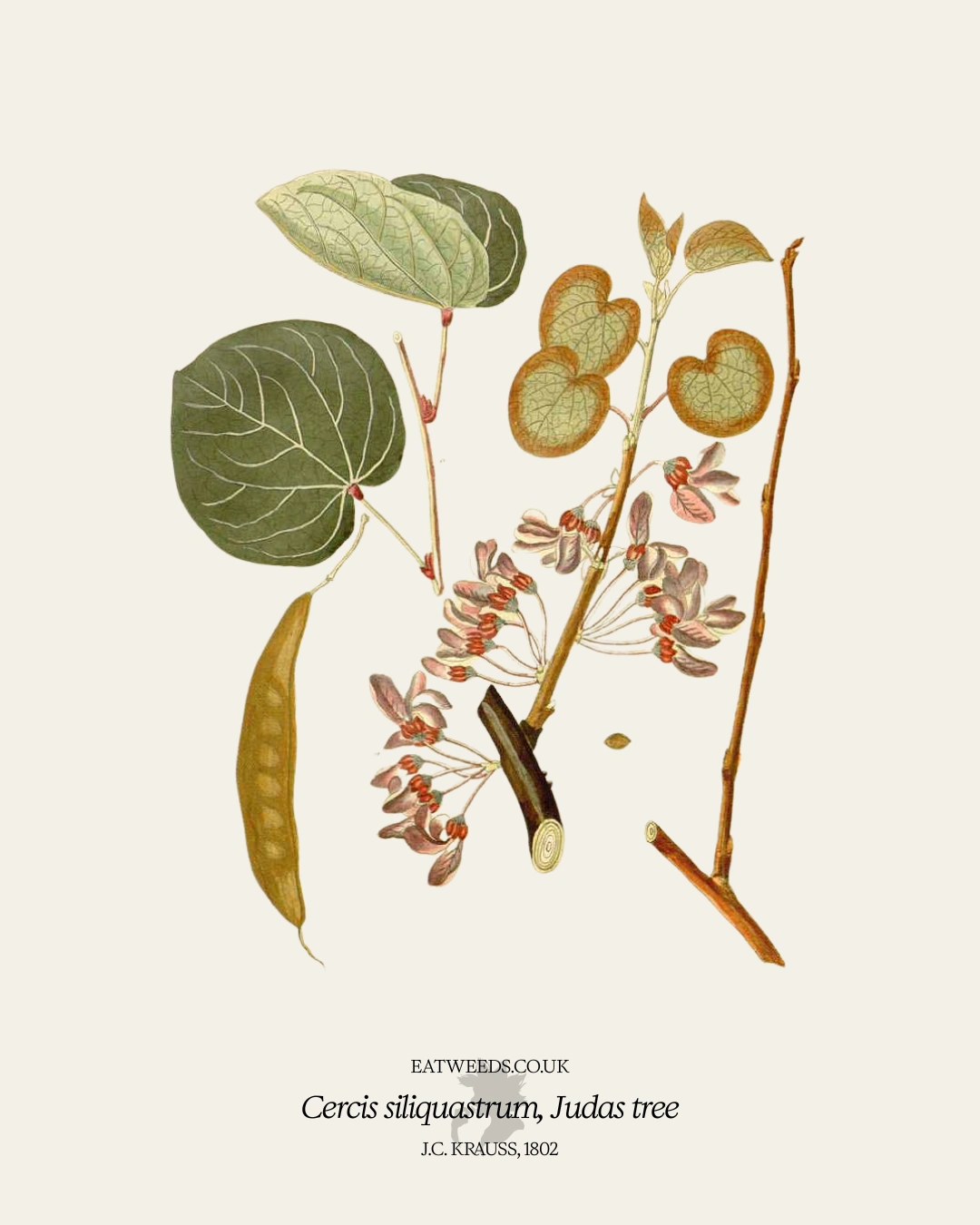
The Judas Tree (Cercis siliquastrum) is a member of the Fabaceae family.
Naturalised in Britain since at least the sixteenth century, carries with it one of the more unfortunate naming confusions in botanical history.
The common name probably arose from a misunderstanding of Arbor Judae (Tree of Judaea). This referred to its widespread cultivation around Jerusalem. By the time it reached England from France, the name had changed to something far more sinister.
Gerard, in his 1597 Herbal, insisted this Mediterranean native was the true tree from which Judas Iscariot hanged himself, not the Elder as was commonly believed.
In contrast to English lore, the French and Italians regarded the Judas Tree as infamous; meanwhile, in Friesland, tradition held it to be a favourite haunt of witches.
However, the Spaniards and Portuguese took a different view entirely, calling it the Tree of Love for its ornamental beauty.
What strikes me about this botanical history is how a linguistic slip gave rise to centuries of superstition around a tree that offers considerable practical value.
Purple-rose flowers bloom directly from the trunk and branch in early spring. These edible flowers, thought to illustrate the tree’s shame, have a sweet-tart flavour and high Vitamin C content.
They’ve been used raw in traditional Istanbul salads, fried as a delicacy, or preserved in jellies and vinegars. The unopened buds, pickled, make an excellent caper substitute.
Transitioning from culinary uses to medicinal applications, there is substantial evidence of the tree’s therapeutic properties across the Mediterranean.
In Syria, the flowers are part of the Unani “Zahraa” herbal tea blend, taken after meals as a digestive; in Central Macedonia, a decoction is used specifically for joint pain and rheumatism.
The buds have been employed as anti-inflammatories and anti-coagulants. Iranians have traditionally used the leaves against malaria and anaemia.
Modern research appears to support these traditional uses. Recent studies show potent antioxidant and antimicrobial activity in the plant’s extracts. The hexane fractions exhibit particularly potent activity against MRSA and other resistant bacteria.
There is also emerging evidence of potential anticancer properties, linked to bioactive compounds including flavonoids and phytol.
The young leaves can be eaten raw or cooked. The immature pods, while bitter, have been pickled or fermented after careful preparation. Even mature seeds, with up to 30% protein, served as a valuable winter food when properly roasted and cooked.
It’s worth noting that the seeds require thorough cooking to neutralise potential antinutrients, as with other members of the Fabaceae family.
But the cautionary tale here is cultural rather than botanical. This shows how easily a geographical reference can become a moral judgment, and how that judgment can then obscure the practical uses of a plant for generations.
References
Amer, J., Jaradat, N., Hattab, S., Al-hihi, S., & Juma’a, R. (2019). Traditional Palestinian medicinal plant Cercis siliquastrum (Judas tree) inhibits the DNA cell cycle of breast cancer – Antimicrobial and antioxidant characteristics. European Journal of Integrative Medicine, 27, 90–96.
Brussell, D. E. (2004). Medicinal plants of Mt. Pelion, Greece. Economic Botany, 58(1), S174–S202.
Dogan, Y., Baslar, S., Ay, G., & Mert, H. H. (2004). The use of wild edible plants in western and central Anatolia (Turkey). Economic Botany, 58(4), 684–690.
Folkard, R. (1884). Plant Lore, Legends, and Lyrics. Sampson Low, Marston, Searle, and Rivington.
Grimes, K. (2025, February 27). Edible Redbud Flowers: The Delicious and Nutritious Harbinger of Spring. The Grow Network. https://thegrownetwork.com/in-praise-of-redbuds/
Ivanova, A., Bogdanova, S., Petrov, V., & Gechev, T. (2025). Plants from Bulgarian Botanical Gardens: Some Selected Species with Potential for Health Food and Medical Applications. Plants, 14(14), 2176.
Lucchetti, L., Zitti, S., & Taffetani, F. (2019). Ethnobotanical uses in the Ancona district (Marche region, Central Italy). Journal of Ethnobiology and Ethnomedicine, 15(1), 9.
Oxford University Plants 400: Cercis siliquastrum. (n.d.).
Spyrou, A., Elvir-Padilla, L. G., Ioannidi, A. A., Mendoza-Castillo, D. I., Bonilla-Petriciolet, A., Santzouk, S., Papadaki, M., & Antonopoulou, M. (2025). Exploring alternative methods for producing extracts with antioxidant and antimicrobial properties from Cercis siliquastrum L. and safety assessment. Sustainable Chemistry and Pharmacy, 45, 102012.
Watts, D. (2007). Dictionary of Plant Lore. Elsevier.