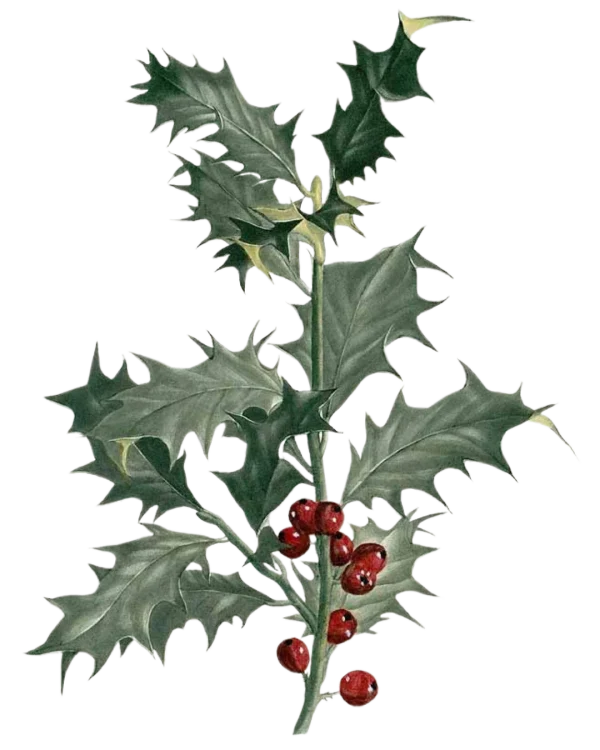
Holly (Ilex aquifolium) is Britain’s most common native evergreen. Its glossy, spiny leaves and red berries have made it the primary Christmas greenery for centuries.
However, behind all the decoration lies a dense body of belief: when you may or may not bring holly into the house, what kind it needs to be and, more importantly, what you must do before it leaves your house after all the Christmas celebration.
When I dug deep into the research, I found that much of the belief contradicts itself, depending on which county you live in.
Most writers trace Christmas holly to pre-Christian midwinter customs, but they disagree on which of those customs is genuine.
One account derives it from the Roman Saturnalia, when holly was considered sacred to Saturn and houses were adorned with it.
Early Christians are said to have followed suit to avoid being noticed by their pagan neighbours.
Folklorists describe the Roman custom of sending evergreen boughs as gifts during Saturnalia. There was apparently also a church edict from Bracara that forbade Christians to decorate their houses alongside the pagans.
A rival theory holds that the Druids decorated their huts with evergreens to shelter woodland spirits.
Then there are more general beliefs, such as evergreen leaves standing for life that continues through winter dormancy.
Christian meanings
As with many pagan rituals and beliefs, Christians absorbed the practices quite easily. The prickly leaves of holly became the crown of thorns, and the red berries Christ’s blood.
An old legend says holly first sprang up in Christ’s footsteps. This gave it the names Christ’s Thorn and Christdorn in Northern Europe, and probably the Old English name Holy Tree.
Apparently the monks changed the name Holly to Holy Tree because of its use in church at Christmas. Others think the name came from “holly” being read as “holy”, and that this lies behind holly’s reputation against witches.
In Fenland there was a belief that a holly stick in the hand scared witches away.
Several local names tie the tree to Christmas. In Suffolk it is known as Christmas Tree; in Cornwall, Prickly Christmas.
Whitby had a Holly Dance at Christmas, and Christmas Common in the Chilterns may have been named after the holly that grows there, because Christmas Tree was an old local name for it.
Hop over to Italy and you’d find mangers decorated at Christmas with moss, cypress and prickly holly in memory of the Christ Child. Holly wreaths were sent as good wishes to friends and family.
Carols and stories
We all know the carol ‘The Holly and the Ivy’. There is much debate over what the two plants symbolise, but the consensus is that many of the older holly and ivy carols were quite bawdy and stood for the sexes: holly the masculine, ivy the feminine.
This has often been interpreted as holly representing Christianity and ivy representing pagan belief. From my research, though, the consensus seems to be that the beliefs around ivy were more secular than spiritual or religious.
There is a 15th-century carol, ‘Here Comes Holly’, which threatens hanging for anyone who speaks against holly.
Here comes Holly that is so gent,
To please all men is his intent.
Alleluia.
But Lord and Lady of this hall,
Whosoever against Holly call.
Alleluia.
Whosoever against Holly do cry,
In a lepe he shall hang full high.
Alleluia.
Whosoever against Holly do sing,
He may weep and hands wring.
Alleluia.
Bringing holly in
As with many folk traditions, timing mattered, and it was deemed unlucky to bring holly in before Christmas Eve. Only a man should carry it in. In Somerset this applied specifically to berried holly.
But it wasn’t just any old holly. It had to be specific. In Derbyshire the Christmas holly had to be partly smooth and partly prickly. Prickly holly symbolised the husband (often called ‘he-holly’) and smooth holly the wife (‘she-holly’).
Whichever type was brought into the house first, or was most abundant, decided who would hold the upper hand in the marriage for the coming year.
At Burford in Shropshire only smooth, berry-free holly was used, and dealers were paid more for spineless (‘slike’) holly than for prickly.
Yet in Somerset, holly without berries was unlucky and dangerous to man and beast. In a berryless year, it was wise to add a sprig of box to the wreath, or a sprig with its berries reddened with raddle (a red pigment made from red ochre), to break the bad luck.
Where it went
In some parts of the country a berried spray was always put in the window, while in America it was considered unlucky to put holly upstairs.
In Cornwall a holly branch was often used instead of a Christmas tree, and in Yorkshire there was a tradition of putting one holly leaf in every room.
In the West of England, a girl would decorate her bed with berried holly on Christmas Eve or risk a visit from a mischievous goblin.
In Wiltshire, Christmas wreaths of holly and bay were hung on doors to keep witches outside. Provided there were more than four berries, the witches would not enter, because they could not count above four.
On the continent, holly cut on Christmas Eve was hung in houses and stables in France, Switzerland and Bologna, in the belief that it would drive out evil spirits and witchcraft.
An old English belief held that unless holly was hung in the house, elves and fairies would join the Christmas gathering. Provided the holly was hung up, it neutralised any power the spirits had to harm the family.
Taking it down
When taking holly down you had to be mindful and do it with intention. Usually the greenery had to go by a specific date, but over time that date has shifted.
It used to be Candlemas Eve, and if you left a leaf behind, a goblin would stay in your house. Every leaf had to go.
Richard Mabey notes that the date moved from early February to Twelfth Night. In Oxfordshire, if you left holly up after 6 January, the devil would fill your house, while on the Isle of Man it stayed up until Shrove Tuesday.
How to dispose of it is just as contradictory. In Somerset, greenery not burned would turn into pixies. In Norfolk, holly had to be burned outdoors, while in Hampshire it was burnt in the garden for luck.
Midwinter divination
Christmas Eve was one of the nights on which the three-pails love spell worked.
Three green holly leaves were pinned over a young girl’s heart, and three pails of water were placed by her bed. During the night the spell would bring a vision of her future husband.
At Hogmanay in the Highlands, a boy who was whipped with holly would live a year for each drop of blood the whipping drew.
The Christmas trade
Christmas holly is also a commercial crop. Tenbury Wells, in Worcestershire, used to hold Britain’s only holly and mistletoe auction in the four weeks before Christmas.
Cutters would buy the rights to trees in summer and cut each one only every three or four years. Unfortunately, large-scale poaching now fells whole trees for their berries.
The last commercial holly farmer in Britain, near Great Yarmouth, reportedly retired in 2000.
References
Bown, D. (2002). The RHS new encyclopedia of herbs & their uses. Dorling Kindersley.
Britten, J., & Holland, R. (1886). A dictionary of English plant-names. Trübner & Co.
Davidson, A. (2014). The Oxford companion to food (T. Jaine, Ed.; 3rd ed.). Oxford University Press.
Folkard, R. (1892). Plant lore, legends, and lyrics. Sampson Low, Marston and Company.
Gibbons, E. (1962). Stalking the wild asparagus. David McKay Company.
Grieve, M. (1971). A modern herbal (C. F. Leyel, Ed.; Vol. 1). Dover Publications.
Hatfield, G. (2007). Hatfield’s herbal: The secret history of British plants. Allen Lane.
Mabey, R. (1998). Flora Britannica: The concise edition. Chatto & Windus.
Sanderson, H., & Prendergast, H. D. V. (2002). Commercial uses of wild and traditionally managed plants in England and Scotland. Royal Botanic Gardens, Kew.
Skinner, A., & Martin, K. (Eds.). (2022). A cultural history of plants in the nineteenth century. Bloomsbury Academic.
Watts, D. C. (2007). Dictionary of plant lore. Academic Press.